A Practical Guide to Start Investing in the Stock Market
Wafaa Khalil
Dec 25, 2025
In this practical guide, my goal is to help you begin your own investment journey in a simple, realistic, and empowering way.
Stock Market
Stock Market
Investments
Investments
A Practical Guide to Start Investing in the Stock Market
Wafaa Khalil
Dec 25, 2025
In this practical guide, my goal is to help you begin your own investment journey in a simple, realistic, and empowering way.
Stock Market
Investments

Hello dear readers,
You may wonder how a financial crisis—and a single moment of courage—reshaped my entire journey into the world of investing.
My story began in 2019, a year when the financial system in my country collapsed due to deep structural corruption. Overnight, families—including mine—lost much of their savings, with no clarity or protection. Shortly after, the world entered the COVID-19 pandemic, triggering a sharp global stock market crash driven by fear and uncertainty.
During those difficult days, one quote kept returning to my mind:
“Be fearful when others are greedy, and be greedy when others are fearful.”
— Warren Buffett
It was a period that demanded not only knowledge, but also the courage to act.
With that courage, I made my first investment by purchasing shares in a Chinese electric vehicle company. At the time, I did not realize that this small step—taken amid global fear—would become a turning point. As the investment grew in value, it sparked a deeper curiosity and a lasting passion for investing.
I chose to strengthen my foundation further by pursuing a master’s degree in applied finance (investing). This experience deepened my understanding of financial markets and reinforced my belief in the power of education, patience, and informed decision-making.
In this practical guide, my goal is to help you begin your own investment journey in a simple, realistic, and empowering way.
The secret of building wealth is simple:
Keep learning, stay patient, and take action when opportunities appear.
Warm regards,
Wafaa Khalil
Disclaimer
Information provided is for guidance only and does not constitute financial advice. We do not manage funds, execute trades, or guarantee outcomes. Independent professional advice is recommended. No liability is accepted for any losses arising from reliance on this information.
Why Should You Invest in Stocks?
Stocks allow you to own a share of successful companies that drive global innovation and economic growth. Instead of building a business from the ground up, investing in stocks enables you to participate in the progress of companies that already have proven products, strong teams, and worldwide demand. History shows that stocks have been one of the most rewarding long-term investments. The historical chart of the S&P 500 below demonstrates how the U.S. stock market has grown consistently over the past 60 years. Even though the chart includes major downturns—such as the dot-com crash, the 2008 financial crisis, and the COVID-19 shock—the long-term trend moves strongly upward. This proves a powerful principle: despite temporary declines, the stock market has historically recovered and reached new highs, rewarding patient investors with substantial long-term growth.
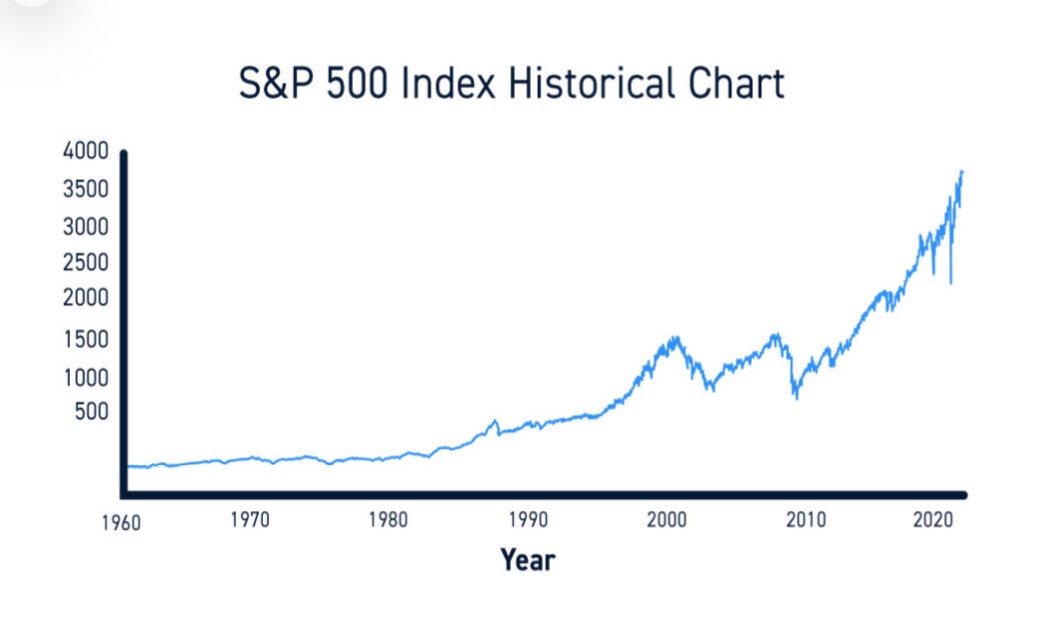
Source: Macrotrends.net
How Do Stocks Generate Returns?
Stocks can provide returns in two main ways: an increase in share price and dividend payments.
1. Capital Appreciation
This is the profit you earn when the stock’s price rises over time. You buy at one price and, if the market moves in your favor, you sell at a higher price.
2. Dividends
Some companies distribute part of their profits to shareholders in the form of regular cash payments called dividends.
Your total return is the combination of both—the price gain plus the dividends received.
Example:
Imagine you bought a share of Company X for $80.
A year later, the share price increased to $120, giving you a $40 gain.
During that same year, Company X paid a dividend of $3 per share.
Your total return would be $43, which represents a 53.75% return on your original investment.
Stock Market and Market Indices
The stock market is a place where people buy and sell financial assets such as stocks, bonds, and other securities. These trades happen on organized exchanges that match buyers with sellers. Today, most trading is done online, and investors hold their shares electronically instead of using paper certificates.
Major exchanges are found in cities like New York, London, and Tokyo. Every company listed on the market has its own ticker symbol, a short code used to identify its stock.
For example: Apple (AAPL), MasterCard (MA), and Facebook (FB)
A market index is a single value that represents the combined performance of a group of selected stocks. By tracking these stocks together, the index shows how a particular market or sector moves over time.
Examples of major global indices include:
Global:
MSCI World Index – tracks around 1,650 companies from developed markets.
United States Indices
Dow Jones Industrial Average (DJIA) – 30 major U.S. companies.
Standard & Poor’s 500 Index (S&P 500) – 500 large U.S. companies.
Standard & Poor’s MidCap 400 Index (S&P 400) – 400 mid-size companies.
Standard & Poor’s SmallCap 600 Index (S&P 600) – 600 small companies.
Nasdaq-100 Index – 100 leading technology and biotech companies.
United Kingdom
Financial Times Stock Exchange 100 Index (FTSE 100) – top 100 companies by market value.
Switzerland
Swiss Market Index (SMI) – 20 large and mid-sized Swiss companies.
Middle East Indices
United Arab Emirates:
Abu Dhabi General Index (ADI) – tracks 37 of the largest listed companies.
Saudi Arabia:
Tadawul All Share Index (TASI) – includes 169 publicly traded companies.
How to Evaluate a Stock?
Evaluating a stock involves understanding both the financial strength of the company and the behavior of its share price in the market. Investors typically rely on two complementary approaches: fundamental analysis and technical analysis.
Fundamental analysis focuses on assessing a company’s overall financial health and long-term potential. This includes reviewing financial statements to determine whether the company is profitable, how efficiently it uses its assets, and whether it manages debt responsibly. Key questions include: Is the company generating sustainable earnings? Is its debt level manageable? Is shareholders’ equity being used effectively to create value? Financial ratios—such as profitability, liquidity, leverage, and efficiency ratios—are commonly used to compare a company with its peers and to judge whether its stock may be undervalued or overvalued.
Technical analysis, on the other hand, concentrates on market behavior rather than company fundamentals. It involves studying price charts, trends, and trading volume to identify patterns and potential future price movements. Technical analysts believe that market prices reflect all available information and that historical price behavior can provide insights into future trends. By analyzing support and resistance levels, momentum indicators, and chart patterns, traders aim to time their entry and exit points to benefit from price movements.
In practice, many investors combine both approaches: fundamental analysis to select strong companies and technical analysis to determine the optimal timing for buying or selling their shares.
How to Search for Stocks?
Finding suitable stocks to invest in starts with using reliable information sources and the right research tools. There is no single method to identify “winning” stocks; instead, successful investors combine multiple sources to build a clear and informed view.
A good starting point is the investor relations section on a company’s official website. Here, you can access annual reports, quarterly earnings releases, financial statements, and management commentary. These documents provide first-hand information about the company’s performance, strategy, risks, and future outlook.
In addition, many well-known financial news and research platforms offer valuable insights, market updates, and investment ideas. Sources such as The Wall Street Journal, Investor’s Business Daily, Barron’s, The Street, Seeking Alpha, Yahoo Finance, and ETF.com provide company analysis, earnings news, valuation metrics, and sector comparisons. Premium research platforms like Morningstar and Value Line offer deeper analysis, fair-value estimates, and long-term investment ratings that can support more informed decisions.
Most brokerage platforms also provide built-in stock screeners and research tools. These allow investors to filter stocks based on criteria such as market capitalization, profitability, growth rates, valuation ratios, and dividends. Platforms like Interactive Brokers offer strong research coverage for both U.S. and international stocks, often at no additional cost.
By combining company reports, financial news, professional research platforms, brokerage tools, and charting platforms, investors can efficiently search for stocks that match their investment goals, risk tolerance, and strategy.
Choose Your Broker
A broker is a government-authorized company that allows investors to buy and sell securities such as stocks and bonds. Choosing the right broker is important because it affects your costs and overall investment returns. Brokers generally fall into two main categories.
Full-service brokers provide investment advice, portfolio management, and research, but they usually charge higher fees. Discount or online brokers focus mainly on providing trading platforms and basic tools, making them more suitable for self-directed investors and typically much lower in cost.
When selecting a broker, pay close attention to fees, including trading commissions, account maintenance fees, currency conversion charges, and any hidden costs. To find low-fee brokers, compare fee structures across platforms, review the pricing details on their websites, read user reviews, and ensure the broker is properly regulated.
A good broker combines low and transparent fees, a reliable platform, and strong regulation, helping investors keep costs low and returns higher.
Hello dear readers,
You may wonder how a financial crisis—and a single moment of courage—reshaped my entire journey into the world of investing.
My story began in 2019, a year when the financial system in my country collapsed due to deep structural corruption. Overnight, families—including mine—lost much of their savings, with no clarity or protection. Shortly after, the world entered the COVID-19 pandemic, triggering a sharp global stock market crash driven by fear and uncertainty.
During those difficult days, one quote kept returning to my mind:
“Be fearful when others are greedy, and be greedy when others are fearful.”
— Warren Buffett
It was a period that demanded not only knowledge, but also the courage to act.
With that courage, I made my first investment by purchasing shares in a Chinese electric vehicle company. At the time, I did not realize that this small step—taken amid global fear—would become a turning point. As the investment grew in value, it sparked a deeper curiosity and a lasting passion for investing.
I chose to strengthen my foundation further by pursuing a master’s degree in applied finance (investing). This experience deepened my understanding of financial markets and reinforced my belief in the power of education, patience, and informed decision-making.
In this practical guide, my goal is to help you begin your own investment journey in a simple, realistic, and empowering way.
The secret of building wealth is simple:
Keep learning, stay patient, and take action when opportunities appear.
Warm regards,
Wafaa Khalil
Disclaimer
Information provided is for guidance only and does not constitute financial advice. We do not manage funds, execute trades, or guarantee outcomes. Independent professional advice is recommended. No liability is accepted for any losses arising from reliance on this information.
Why Should You Invest in Stocks?
Stocks allow you to own a share of successful companies that drive global innovation and economic growth. Instead of building a business from the ground up, investing in stocks enables you to participate in the progress of companies that already have proven products, strong teams, and worldwide demand. History shows that stocks have been one of the most rewarding long-term investments. The historical chart of the S&P 500 below demonstrates how the U.S. stock market has grown consistently over the past 60 years. Even though the chart includes major downturns—such as the dot-com crash, the 2008 financial crisis, and the COVID-19 shock—the long-term trend moves strongly upward. This proves a powerful principle: despite temporary declines, the stock market has historically recovered and reached new highs, rewarding patient investors with substantial long-term growth.
Source: Macrotrends.net
How Do Stocks Generate Returns?
Stocks can provide returns in two main ways: an increase in share price and dividend payments.
1. Capital Appreciation
This is the profit you earn when the stock’s price rises over time. You buy at one price and, if the market moves in your favor, you sell at a higher price.
2. Dividends
Some companies distribute part of their profits to shareholders in the form of regular cash payments called dividends.
Your total return is the combination of both—the price gain plus the dividends received.
Example:
Imagine you bought a share of Company X for $80.
A year later, the share price increased to $120, giving you a $40 gain.
During that same year, Company X paid a dividend of $3 per share.
Your total return would be $43, which represents a 53.75% return on your original investment.
Stock Market and Market Indices
The stock market is a place where people buy and sell financial assets such as stocks, bonds, and other securities. These trades happen on organized exchanges that match buyers with sellers. Today, most trading is done online, and investors hold their shares electronically instead of using paper certificates.
Major exchanges are found in cities like New York, London, and Tokyo. Every company listed on the market has its own ticker symbol, a short code used to identify its stock.
For example: Apple (AAPL), MasterCard (MA), and Facebook (FB)
A market index is a single value that represents the combined performance of a group of selected stocks. By tracking these stocks together, the index shows how a particular market or sector moves over time.
Examples of major global indices include:
Global:
MSCI World Index – tracks around 1,650 companies from developed markets.
United States Indices
Dow Jones Industrial Average (DJIA) – 30 major U.S. companies.
Standard & Poor’s 500 Index (S&P 500) – 500 large U.S. companies.
Standard & Poor’s MidCap 400 Index (S&P 400) – 400 mid-size companies.
Standard & Poor’s SmallCap 600 Index (S&P 600) – 600 small companies.
Nasdaq-100 Index – 100 leading technology and biotech companies.
United Kingdom
Financial Times Stock Exchange 100 Index (FTSE 100) – top 100 companies by market value.
Switzerland
Swiss Market Index (SMI) – 20 large and mid-sized Swiss companies.
Middle East Indices
United Arab Emirates:
Abu Dhabi General Index (ADI) – tracks 37 of the largest listed companies.
Saudi Arabia:
Tadawul All Share Index (TASI) – includes 169 publicly traded companies.
How to Evaluate a Stock?
Evaluating a stock involves understanding both the financial strength of the company and the behavior of its share price in the market. Investors typically rely on two complementary approaches: fundamental analysis and technical analysis.
Fundamental analysis focuses on assessing a company’s overall financial health and long-term potential. This includes reviewing financial statements to determine whether the company is profitable, how efficiently it uses its assets, and whether it manages debt responsibly. Key questions include: Is the company generating sustainable earnings? Is its debt level manageable? Is shareholders’ equity being used effectively to create value? Financial ratios—such as profitability, liquidity, leverage, and efficiency ratios—are commonly used to compare a company with its peers and to judge whether its stock may be undervalued or overvalued.
Technical analysis, on the other hand, concentrates on market behavior rather than company fundamentals. It involves studying price charts, trends, and trading volume to identify patterns and potential future price movements. Technical analysts believe that market prices reflect all available information and that historical price behavior can provide insights into future trends. By analyzing support and resistance levels, momentum indicators, and chart patterns, traders aim to time their entry and exit points to benefit from price movements.
In practice, many investors combine both approaches: fundamental analysis to select strong companies and technical analysis to determine the optimal timing for buying or selling their shares.
How to Search for Stocks?
Finding suitable stocks to invest in starts with using reliable information sources and the right research tools. There is no single method to identify “winning” stocks; instead, successful investors combine multiple sources to build a clear and informed view.
A good starting point is the investor relations section on a company’s official website. Here, you can access annual reports, quarterly earnings releases, financial statements, and management commentary. These documents provide first-hand information about the company’s performance, strategy, risks, and future outlook.
In addition, many well-known financial news and research platforms offer valuable insights, market updates, and investment ideas. Sources such as The Wall Street Journal, Investor’s Business Daily, Barron’s, The Street, Seeking Alpha, Yahoo Finance, and ETF.com provide company analysis, earnings news, valuation metrics, and sector comparisons. Premium research platforms like Morningstar and Value Line offer deeper analysis, fair-value estimates, and long-term investment ratings that can support more informed decisions.
Most brokerage platforms also provide built-in stock screeners and research tools. These allow investors to filter stocks based on criteria such as market capitalization, profitability, growth rates, valuation ratios, and dividends. Platforms like Interactive Brokers offer strong research coverage for both U.S. and international stocks, often at no additional cost.
By combining company reports, financial news, professional research platforms, brokerage tools, and charting platforms, investors can efficiently search for stocks that match their investment goals, risk tolerance, and strategy.
Choose Your Broker
A broker is a government-authorized company that allows investors to buy and sell securities such as stocks and bonds. Choosing the right broker is important because it affects your costs and overall investment returns. Brokers generally fall into two main categories.
Full-service brokers provide investment advice, portfolio management, and research, but they usually charge higher fees. Discount or online brokers focus mainly on providing trading platforms and basic tools, making them more suitable for self-directed investors and typically much lower in cost.
When selecting a broker, pay close attention to fees, including trading commissions, account maintenance fees, currency conversion charges, and any hidden costs. To find low-fee brokers, compare fee structures across platforms, review the pricing details on their websites, read user reviews, and ensure the broker is properly regulated.
A good broker combines low and transparent fees, a reliable platform, and strong regulation, helping investors keep costs low and returns higher.
Related Blogs
Discover more blogs that drove real results and helped clients achieve measurable, lasting growth worldwide.

Selecting Potential Stocks
Learn how clear planning creates client confidence, boosts credibility & drives steady business growth.
Stock Market
Investments
Selecting Potential Stocks
Learn how clear planning creates client confidence, boosts credibility & drives steady business growth.
Stock Market
Investments
Selecting Potential Stocks
Learn how clear planning creates client confidence, boosts credibility & drives steady business growth.

Learn From the Stock Market Gurus
Understanding how the market masters work.
Stock Market
Investments
Learn From the Stock Market Gurus
Understanding how the market masters work.
Stock Market
Investments
Learn From the Stock Market Gurus
Understanding how the market masters work.
Start Your Investment Journey with Clarity.
Share your objectives and questions and we will walk you through possible approaches, risks, and next steps in a calm, structured way.
Start with a Strategy Call
Start Your Investment Journey with Clarity.
Share your objectives and questions and we will walk you through possible approaches, risks, and next steps in a calm, structured way.
Start with a Strategy Call
Ready to
accelerate your business growth?
Share your objectives and questions and we will walk you through possible approaches, risks, and next steps in a calm, structured way.